There's something I've been thinking about since we added a small new feature to KindCoin.
It's called partial approval. And on the surface it sounds like a product thing — a little stepper that lets a parent reduce the KindCoins they award for a check-in. But the reason I wanted to build it is something I kept running into in real life, and I suspect a lot of parents will recognize it.
Your child had a hard day. Not a bad kid day. Just a hard one. Maybe there was a moment of frustration that didn't get handled well. Maybe homework turned into a battle. Maybe the sibling who usually gets a pass didn't get a pass today, and everyone felt it.
And then, at the end of all of that, your child sits down and checks in. They write their reflection. They did the thing they were supposed to do — they noticed a moment of kindness, they put it into words, they sent it to you.
What do you do with that?
Before, the only options were: approve and give the full points, or decline. Full credit or none. And that felt wrong to me. Because parenting doesn't work in absolutes. The full-credit moment and the difficult day both happened. Both are real. Both deserve a response.
So now, when a parent opens a check-in, there's a small stepper next to the approval button. It starts at the full default — whatever that behavior is worth. And the parent can slide it down, a point at a time, if the day calls for it. They still approve. They still write back. But they can say, in the most concrete way possible: I see what you did, and I see how the rest of today went.
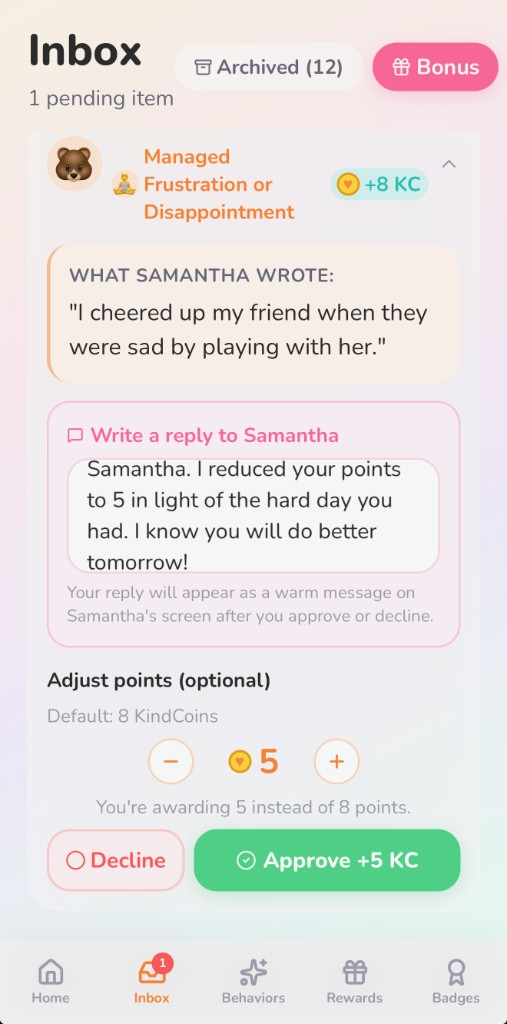
The message it sends
What I love about this is that it doesn't punish the reflection. The child still did the right thing by checking in. They still get credit. They still hear from their parent. The loop still closes.
But the number on their screen — the KindCoins they earned — reflects something real. Not just the behavior they logged, but the full picture of the day their parent witnessed.
Kids understand that. Better than we sometimes expect. A child who has a rough day knows they had a rough day. When a parent acknowledges it honestly — not harshly, but honestly — it often lands better than pretending it didn't happen.
What to write when you adjust
The reply box matters most here. When you reduce the points, KindCoin gently changes the placeholder text:
"Tell them what you're proud of, why you adjusted their points today, and what you know they can do better tomorrow."
That's the whole spirit of it. You're not lecturing. You're not taking something away to punish. You're saying: here's what I noticed, here's what I believe about you, here's what I know you're capable of.
That's a conversation worth having. And for a lot of families, it's one that never quite happens — not because parents don't want to have it, but because there's no natural moment for it.
This gives you the moment.
It can also go the other way
One more thing worth saying. The stepper only goes down — a parent can award less than the default, never more. But the default can be as high as a parent sets it.
If a child had an extraordinary day — if they did something that genuinely surprised you, something that went far beyond what anyone expected — that's what the bonus KindCoins feature is for. That's a different kind of moment, and it deserves its own button.
Partial approval is for the real, ordinary, complicated days. The ones that were mostly good, or mostly hard, or somewhere in between.
Which is most of them.
KindCoin is a behavior and reflection app for families. Kids check in on kindness habits, write what happened, and parents write back. We're inviting a small group of founding families to try it — free through beta and six months after.
Become a Founding Family →More from the blog
More thoughts on raising kinder kids