There's one small question I wish someone had handed me years ago.
That's it. It seems almost too small to matter. But notice what it does that "how was your day?" doesn't.
- It asks for one thing, not a summary — so it's easy to answer.
- It points at something specific and recent — so there's an actual memory to reach for.
- And it quietly aims a child's attention at the good part of the day. Most of us, kids included, default to scanning for what went wrong. This question gently turns the flashlight the other way.
You're not just getting a better answer. You're teaching a habit of noticing — the habit of looking back over a day and finding something worth keeping.
What happens after the first answer
The first answer is usually small. "We had pizza at lunch." That's fine. Don't rush past it — that's the whole moment.
The real magic is in what you do next. You stay curious for one more beat.
"Oh? Who did you sit with?"
"Was it a good pizza day or a bad pizza day?"
"What made it better than yesterday?"
You're not interrogating. You're showing them that what they noticed was worth hearing. And kids, like all of us, talk more when they feel heard. The second answer is almost always bigger than the first.
What this looks like in practice
This is exactly the rhythm I tried to build into KindCoin — because the hardest part of a good habit isn't having the idea, it's remembering to do it every single day. The app just gives the question a place to live.
Instead of a vague "how was your day?", the app asks the child about one specific thing — a moment of kindness, a hard feeling they handled, a time they helped someone. Then it hands them the pen.
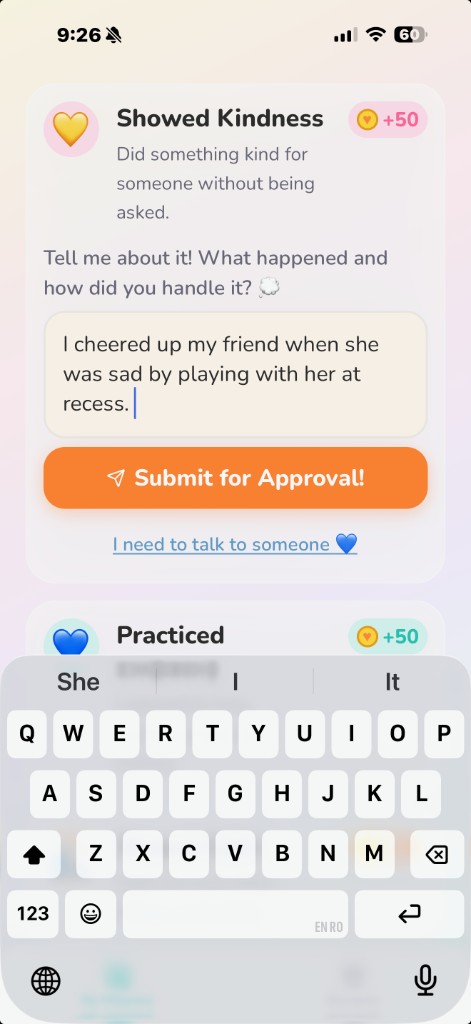
That's the part I care about most. The child writes the answer in their own words. Not a tap, not a checkbox — a real sentence about a real moment, the way they'd tell it. For a lot of kids, it's the first time anyone has asked them to put a good moment into words and then actually waited to hear it.
And then the loop closes. The reflection lands with the parent, who reads what their child wrote — and writes back. That loop is the bridge between children and parents: a child putting a good moment into words, and a parent who actually receives it.
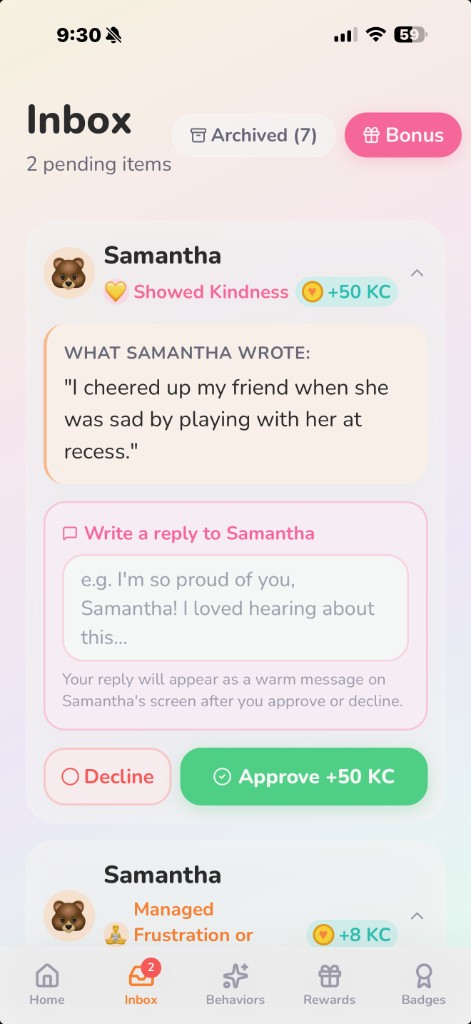
That reply shows up on the child's screen as a warm little message from someone they love. Not a correction. Not a reminder. Just: I read what you wrote, and I'm proud of you.
You don't need an app to ask a better question. But if you've ever meant to start a habit like this and watched it quietly fall off by Wednesday, having something that asks the question for you — every day, in your child's pocket — is what turns a nice idea into a routine your family actually keeps.
Try It With KindCoin
If that loop resonates — a small daily question, the child's own words, a parent who reads it and writes back — that's the whole idea behind KindCoin. We're inviting a small group of founding families to try it through Apple TestFlight and help shape what we build next.
More from the blog
More thoughts on raising kinder kids